Location https://w3w.co/hatch.falls.paths
The town of Waltham Abbey sits to the north of London and is easily accessible from Junction 26 of the M25. Its most famous association is that of being King Harold II final resting place, something that has become part of its identity so much so that it appears on its sign.

The town is interesting for lots of reasons, from sitting directly on the Greenwich Meridian to being the location for Royal Gunpowder Mills and now home of the Olympic White Water Centre. However, it conceals a number of falsehoods, the most obvious of which is that it hasn’t been an Abbey for nearly 500 years, although it was the last one to be dissolved when it was surrendered to Henry VIII’s forces in March 1540. Today the church is formally called ‘The Abbey Church of Waltham Holy Cross and St Lawrence’ and it still does parish duties.

The building that sits on the site has gone through many changes. The Church of England recognises that the current building is the fourth one on the site, but this number might be much more depending on whether only complete rebuilds are counted.
The first church dates back to the beginning of the 7th Century and was likely to have been a small wooden building that was constructed sometime around 610CE by King Sæberht of Essex. This is the same king who may well be buried at Prittlewell! This church lasted around a hundred years and perhaps was not in the best of shape at the end of that period because the East Saxon Kingdom reverted to Paganism after Sæberht’s death. Whatever its state it was replaced by a stone-built church in the second half of the eighth century when Offa of Mercia took control of that area.

The third church was built by Harold Godwinson, who would later become the famous king, but at that time was Earl of Essex and East Anglia. The legendary cause of its rebuilding originates in the manuscript ‘De Inventions Sanctce Crucis Nostras’ which was written in the 12th Century. This story tells how Tovi the Proud, who was a Thane and a court official to King Cnut, came into possession of a black marble crucifix. This was dug up on top of a hill in Montacute, Somerset after a local Blacksmith had a vision. Tovi decided that the crucifix needed to be displayed properly in a church. However, the team of 24 oxen refused to move until the name of Waltham was mentioned and this was taken to be a divine sign of its future location. Once installed at Waltham the crucifix soon became an object of pilgrimage. People came to pray in front of it to seek healing. The legend is that one of these pilgrims who came in the 1050s after he was stricken by an illness while fighting in Wales was Harold. The crucifix apparently did its work, and he was miraculously cured, so in gratitude he rebuilt the church on a grander scale, apparently based on the old St Peter’s in Rome which Harold had visited. This church was consecrated to the Holy Cross in 1060 and Harold also gave the church a substantial amount of additional property to control as well to increase its wealth. The church remained under the control of Tovi until he died, at which point Harold was formally given control of it by Edward the Confessor.
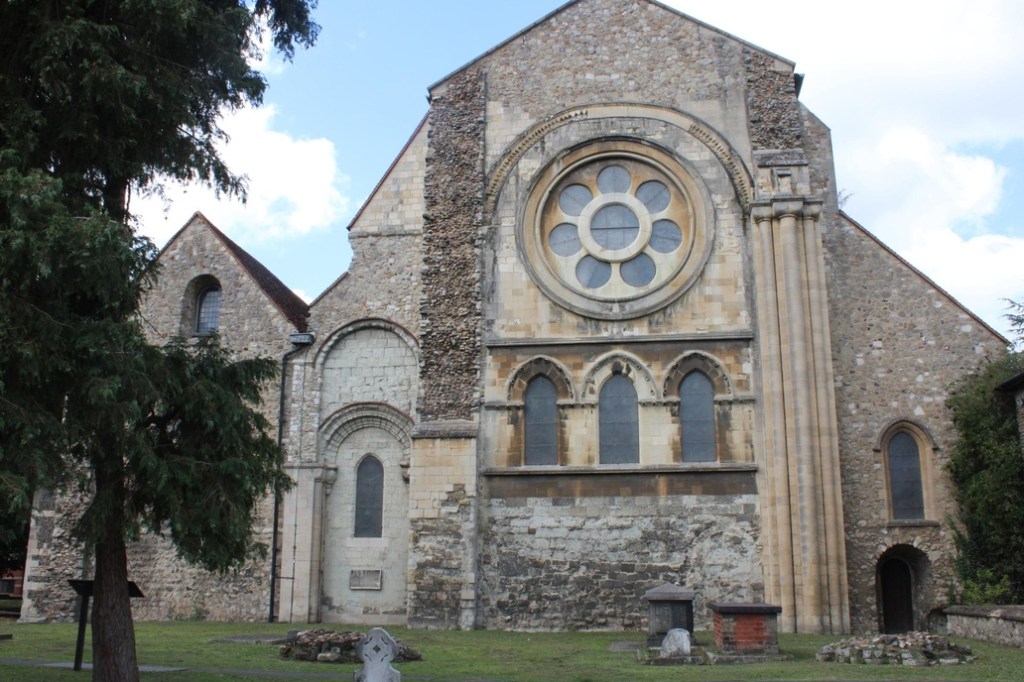
The fate of the Abbey turned with the death of Harold at the Battle of Hastings. Legend has it that his body was brought to Waltham for burial near to the High Altar which today is marked by a stone slab outside in the churchyard where the altar would have stood. However, there is debate about the authenticity of this claim, and while the notion of Harold being laid to rest in a place he so dearly loved adds a degree of poignancy to the Abbey’s history, there is good reason to believe he is elsewhere. Excavation at this site has revealed no body which may be because immediately after his death the Normans would have had no great love for him, nor would they have wanted to provide a focal point for anyone to visit. The reason for the Abbey to have claimed that his body eventually arrived there could simply have been to benefit from pilgrimages by Anglo-Saxons when it was safe to do so. Also, there are competing theories that his body could be at Bosham Church in West Sussex, or that it may never have left the area where he was killed according to the manuscript ‘Gesta Guillelmi’ written by William of Poitiers. Indeed, the manuscript ‘Vita Haroldi’ that was written shortly after his death somewhat unconvincingly claims that he never died at all but was very badly wounded. What is likely is that his body would have been abandoned at the battle site and that very few, if any, of the French would recognise his body and even if they had would not have treated it with any respect.

Following the battle, Harold’s version of the church survived for about 30 years until it was demolished and rebuilt in a Norman style. However, this fourth church did reuse some of the previous Saxon foundations and some of the stonework, so it was not completely lost.
This version lasted until 1177, when it was re-founded as a priory of Augustinian by Henry II as part of his penance for the murder of Thomas Becket. Again, much of the church was demolished and rebuilt which could be thought of as the start of a fifth church on the site. This was not the last close royal association because the Abbey became a favourite place of Henry VIII and may ironically have been the location where the idea of the dissolution formed. Henry’s love of it could explain why Waltham Abbey was the last to go. It is also about this time that the Holy Cross of Waltham is thought to have disappeared.
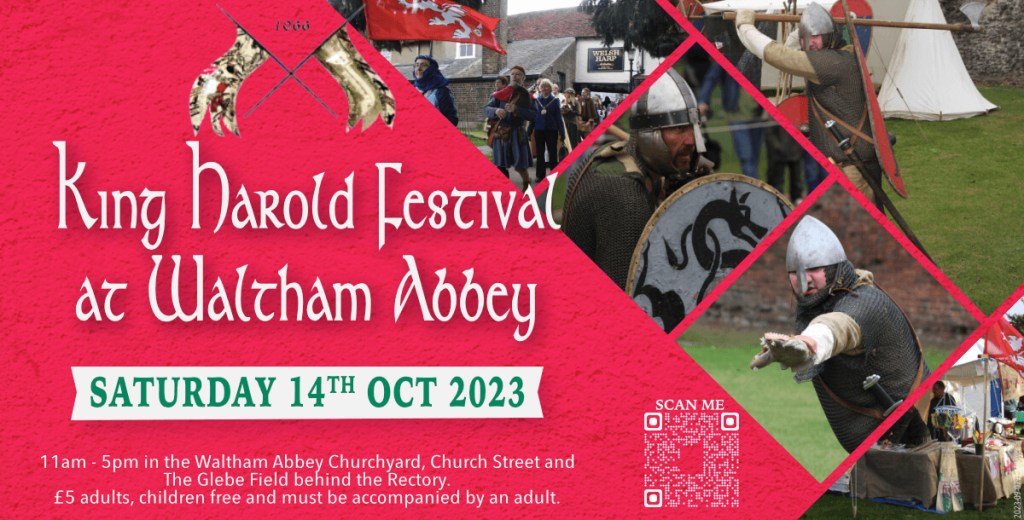
Despite all these other royal links, the town of Waltham Abbey has chosen to strongly associates itself with King Harold. For nearly 20 years the King Harold Day Society has organised a medieval festival in Abbey Gardens in October to commemorate him and keep his memory alive.
Links:
- The Church website – https://walthamabbeychurch.co.uk/history.htm
- Wikipedia – https://en.wikipedia.org/wiki/Waltham_Abbey
- Legend of Montacute’s Crucifix – https://stcatherinesmontacute.co.uk/the-legend-of-montacute/
- Dissolution of the Abbey – https://www.tudorsociety.com/23-march-the-last-abbey-is-dissolved/
- About the Vita Haroldi – http://www.medievalhistory.net/page008b.htm
- About William of Poitiers’s Gesta Guillelmi – https://discovery.ucl.ac.uk/id/eprint/1495348/1/Winkler_EAW%20JMH%20Article%20Open%20Access%20Deposit%202016.pdf
 Anglo-Saxon Essex